Loading...
Healthcare sector
Healthcare IT relocation in Alberta
EMR platforms, PACS archives, laboratory and pharmacy systems and biomedical device networks, moved under the safeguards Alberta custodians are required to maintain. Health information is tracked at the drive, not at the pallet.
Regulatory frame
PIPEDA and the Alberta Health Information Act
Alberta healthcare buyers procure against PIPEDA and the Health Information Act. HIPAA is a United States statute and has no application to an Alberta custodian. The controls below are written against the frameworks that actually govern the record.
Custodian obligations under the HIA
Alberta’s Health Information Act places the duty on the custodian — the health authority, physician, pharmacist or clinic that holds the record. A relocation contractor does not inherit that duty and cannot discharge it on your behalf. What a contractor can do is work inside it: documented safeguards, a named crew list, restricted access to media, and a written record of where every device was between decommission and reconnection.
Administrative, technical and physical safeguards
The HIA requires custodians to take reasonable steps to protect health information against loss, unauthorized access, use and disclosure. On a move that translates into concrete controls: sealed and numbered media containers, drives removed and transported separately from chassis, no unescorted access to clinical areas, and a manifest that reconciles at both ends before crews leave site.
Information manager agreements
Where a contractor will process, store, retrieve or dispose of health information on a custodian’s behalf, the HIA contemplates a written information manager agreement setting out what the contractor may do with the information and what it must do at the end of the engagement. If your privacy office requires one before the move date, tell us during scoping so the scope of work and the agreement describe the same activity.
PIPEDA and the commercial contractor
PIPEDA governs how a private-sector contractor collects, uses and discloses personal information in the course of commercial activity. It applies to us as a vendor regardless of the HIA duty sitting with you. In practice the two frameworks converge on the same requirements: limited collection, limited retention, safeguards proportionate to sensitivity, and accountability that can be evidenced after the fact.
Privacy impact assessment considerations
A PIA is normally required before a custodian implements a new practice or information system, or changes an existing one, and is submitted to the Office of the Information and Privacy Commissioner of Alberta. A relocation is often treated as an amendment rather than a new assessment, but that judgement belongs to your privacy office. We supply the operational inputs a PIA needs: the movement path, who has access, how media is handled, and how disposal is evidenced.
Health information on decommissioned drives
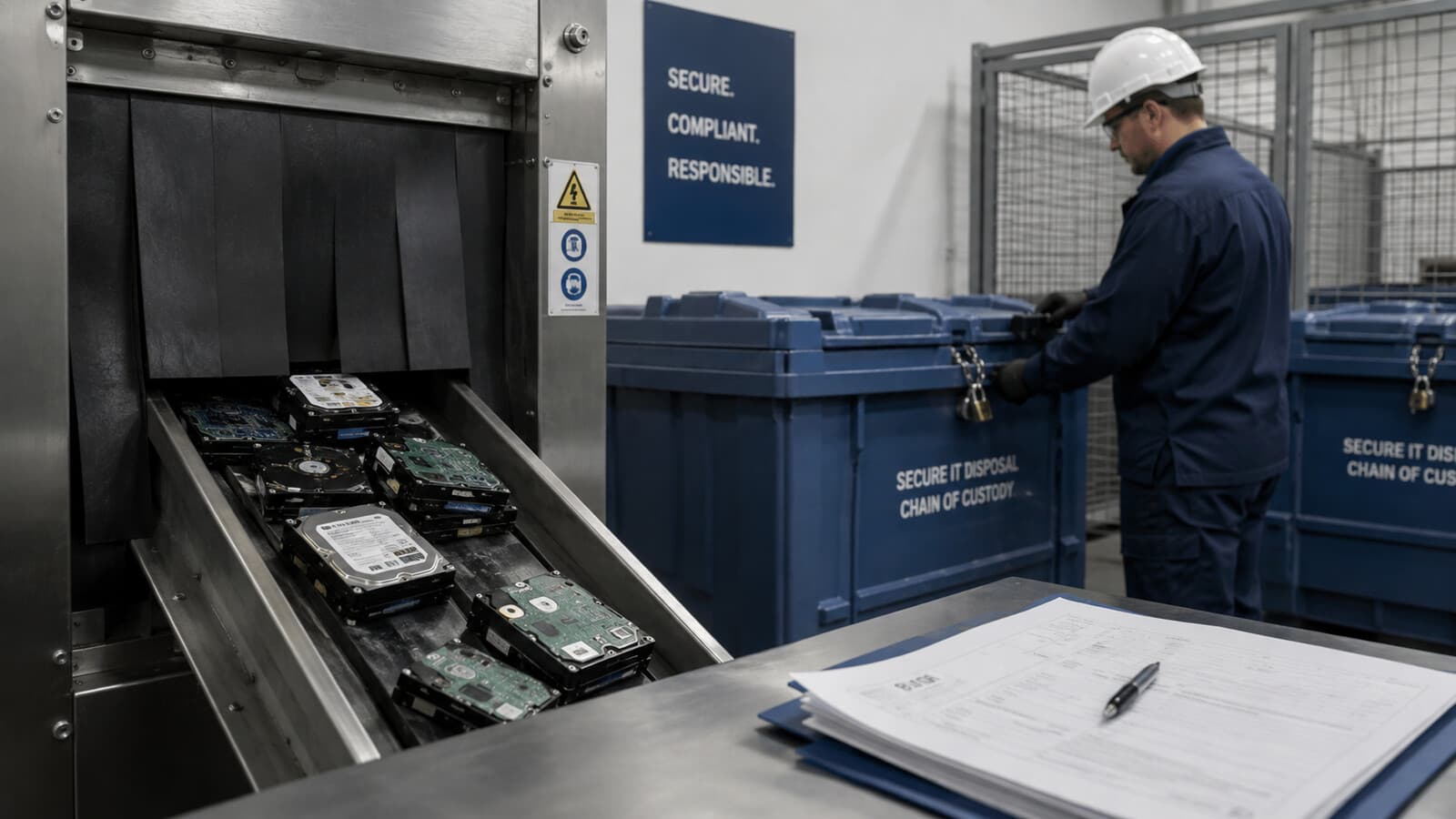
Retired arrays and end-of-life workstations are where health information most often leaks out of a move. Drives are inventoried by serial number at removal, held under seal, and either purged or physically destroyed. Certificates of destruction are issued against the serial list, not against a pallet count, so the record your health information manager receives reconciles device by device with the asset register.
None of this is legal advice, and Caliber does not act as your privacy office. The point is narrower: the operational record a relocation produces should be good enough that your privacy office can answer a question about it two years later without calling us.
Clinical systems
What is actually being moved
A hospital or clinic move is not one system. It is a stack of interdependent ones, several of which are invisible until they stop resolving.
EMR and clinical information systems
Electronic medical record platforms, patient administration systems and the clinical databases behind them are moved against a cutover plan written with the clinical informatics team. Downtime procedures, order sets and paper fallback are confirmed as live before anything is powered down.
PACS and diagnostic imaging
Picture archiving and communication systems carry large storage arrays and strict retrieval expectations. Modality worklists, DICOM routing and archive tiers are documented before disconnection so studies resolve from the same paths after the rebuild.
Laboratory, pharmacy and departmental systems
LIS, pharmacy and departmental applications sit behind interface engines that are easy to overlook. Interface endpoints, ports and certificates are captured in the port map so integrations come back rather than being rebuilt from memory at 3 a.m.
Biomedical device networks
Monitoring, telemetry and connected biomedical equipment often sit on segregated VLANs with their own addressing. Those segments are mapped and validated separately from the corporate network, and biomedical engineering is included in the sign-off.
Continuous facility operation
Acute care does not close. Work is sequenced around clinical schedules, theatre lists and departmental downtime tolerance, with a rollback point defined before each phase rather than improvised during it.
Access, escorting and site protocol
Clinical areas have infection control, escorting and badging requirements that govern how equipment moves through the building. Route, elevator and dock access are walked and agreed before the move date, not negotiated on the night.
Media handling
Decommissioned drives are the exposure
Most health information that escapes a relocation does not escape in transit. It escapes at the end, on hardware nobody wrote down.
Retired arrays, replaced workstations, spare chassis in a storage room, and the imaging cart that stopped being used in 2019 all hold health information. A move is the moment those devices surface, and it is also the moment they are easiest to lose track of, because they are being handled by more people than usual in a shorter window than usual.
The control is a register, not a policy. Every device that holds or may hold health information is recorded by serial number when it is removed. Removable media is sealed into numbered containers at the point of removal rather than at the loading dock. Devices are then either reinstalled at the destination, held under seal pending a decision, or destroyed. There is no fourth outcome, and the register has to close.
Destruction is evidenced against that serial list. A certificate covering “one pallet of mixed media” is not evidence a custodian can rely on. A certificate that names the serials it covers reconciles with the asset register, and the asset register reconciles with the register of what was in the room before the move started.
Where the destination is a new build and the source lease is ending, the decommission scope is planned at the same time as the move scope. Handing an empty room back to a landlord is a deliverable with its own documentation, and it is far cheaper to schedule it once than to send crews back for the equipment that was left in the comms room.
Sequence
How a healthcare move is staged
The standard six-stage Caliber process, with the privacy and clinical checkpoints a health custodian needs added at each end.
Scope and privacy alignment
- Site walkthrough of source and destination clinical areas
- Confirmation of the custodian, the privacy contact and any information manager agreement
- Review of downtime tolerance with clinical operations
- Access, escorting and infection control requirements documented
Documentation and mapping
- Asset register built to serial-number level, including removable media
- Port mapping of clinical, biomedical and corporate network segments
- Interface endpoints and dependencies recorded for EMR, LIS, pharmacy and PACS
- Classification of which devices hold health information and how each will be handled
Decommission and transit
- Controlled shutdown following the sequence agreed with clinical IT
- Drives removed and moved under separate seal where the custodian requires it
- Antistatic wrapping, custom carts and insured vehicles with documented custody
- Manifest reconciled at the destination dock before unwrapping begins
Rebuild, validation and record
- Re-rack and re-cable to the mapped topology
- Interface and retrieval testing with clinical and biomedical staff present
- Certificates of destruction issued against the serial list for retired media
- Custody and validation documentation handed to the health information manager
Services
Services healthcare clients use
Every core Caliber service is available to Alberta health custodians, clinics and imaging centres.
Hospital data centre relocation
Full-facility moves for hospital and health authority data centres, sequenced around clinical downtime tolerance.
data centre relocation in CalgaryEMR and PACS server moves
Individual servers and storage arrays moved with documented chain of custody and validation at the destination.
server relocation for clinical systemsClinic and workstation moves
Exam room workstations, carts, printers and network gear relocated across clinics and imaging centres.
IT equipment relocationDrive destruction and asset disposal
Serial-level asset reporting, certified destruction of health information media, and compliant recycling.
certified data destruction and IT disposalStructured cabling for clinical space
Cat 6 and fibre installs for new clinical builds, imaging suites and departmental network segments.
structured data cablingWhole-facility office moves
Administrative floors moved alongside the clinical scope so a single project manager owns the whole schedule.
office relocation with IT on the critical pathFor worked examples of how phased migrations, decommissions and validation are documented, read the IT relocation case studies. Operators in regulated sectors with comparable audit requirements are covered on the oil and gas IT relocation page, and general questions about scoping, insurance and scheduling are answered in the IT relocation FAQ.
Common questions
What health custodians ask
Does the Alberta Health Information Act apply to an IT relocation contractor?
The HIA places its duties on the custodian, not on the contractor. The contractor works inside those duties. That means documented safeguards, a named crew list, restricted access to media, and a written record of where each device was between decommission and reconnection, so the custodian can evidence that reasonable steps were taken.
Will you sign an information manager agreement before the move?
Where the engagement involves processing, storing, retrieving or disposing of health information on a custodian's behalf, an information manager agreement is the normal instrument. Raise it during scoping so the agreement and the statement of work describe the same activity and the same end-of-engagement obligations.
How is health information handled once drives leave the building?
Drives are inventoried by serial number at removal, sealed in numbered containers, and transported separately from the chassis where the custodian requires it. Custody is documented from removal to either reinstallation or destruction, and the manifest is reconciled at both ends before crews leave site.
Do we need a privacy impact assessment for a clinical system move?
That judgement belongs to your privacy office. A relocation is often handled as an amendment to an existing assessment rather than a new one. Either way we supply the operational inputs the assessment needs: the movement path, who has access to media, how devices are handled in transit, and how disposal is evidenced.
How are PACS storage arrays moved without losing imaging studies?
Archive tiers, DICOM routing and modality worklists are documented before disconnection, and the destination rack layout is confirmed while the array is still running. After the rebuild, retrieval is tested against known studies with imaging staff present before the system is released back to clinical use.
Can a hospital move happen without taking clinical systems offline?
Rarely without any outage, but the outage can be bounded. Systems are grouped by downtime tolerance, moved in phases, and each phase has a defined rollback point. Downtime procedures and paper fallback are confirmed as live before the first shutdown rather than assumed.
What documentation does the health information manager receive?
An asset register to serial-number level, chain of custody records for every device that held health information, validation results from the destination, and certificates of destruction issued against the serial list for any media that was purged or destroyed.
Send us the system list and the downtime you can tolerate.
We’ll come back with a phased plan, a custody model and the documentation your privacy office will ask for.