Loading...
IT movers in Calgary for workstation & IT equipment relocation
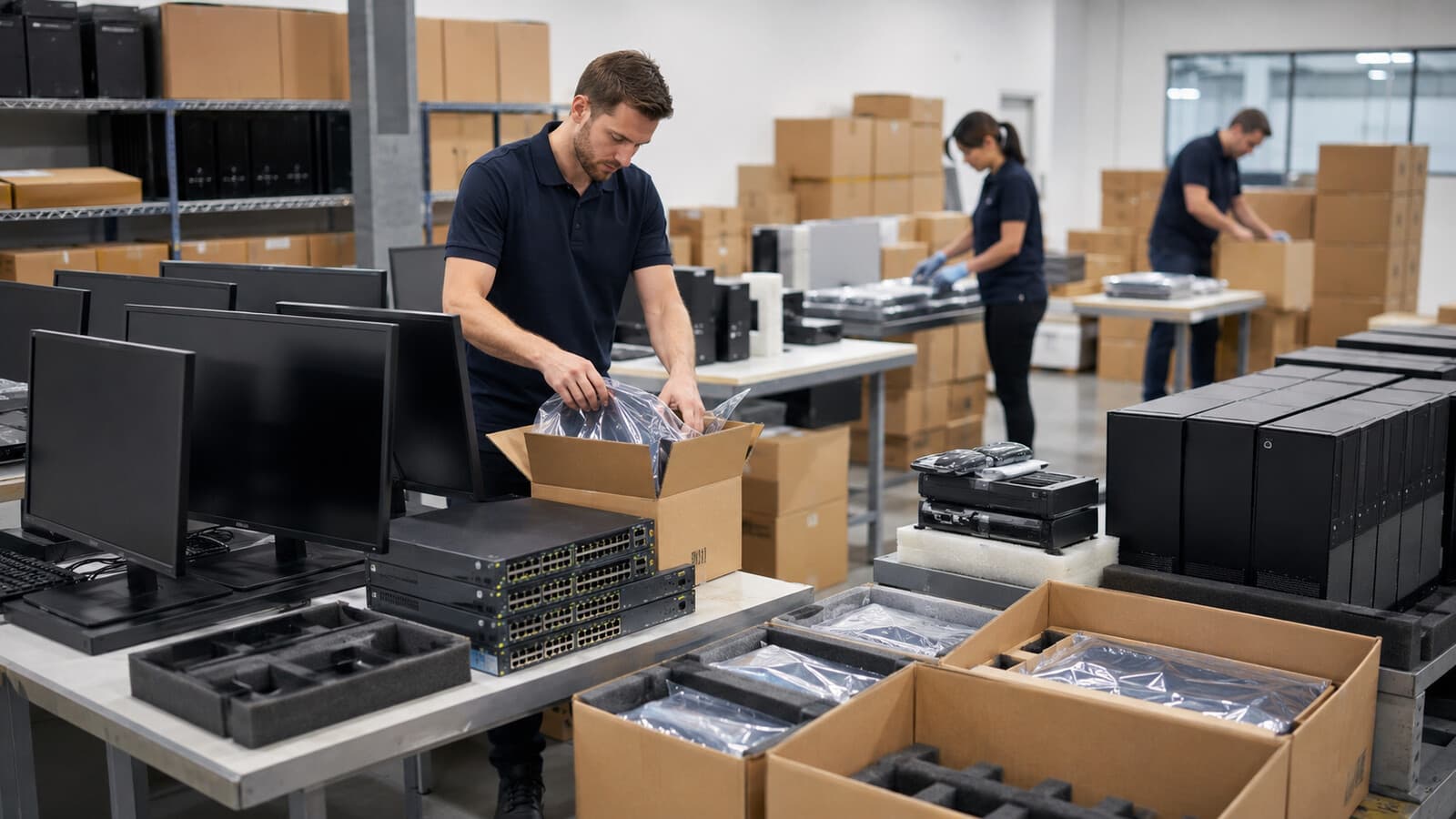
Desktops, monitors, docking stations, printers, meeting-room AV and the network gear on the office floor. Disconnected and labelled per user, moved as complete sets, and reconnected and tested desk by desk.
Overview
The move is judged on Monday morning, one desk at a time
An office IT move is not a hard technical problem. It is a volume problem with no tolerance for error. Two hundred desks means two hundred sets of hardware that have to arrive complete, at the right position, plugged back in the way the person left them. One dock in the wrong crate is not a technical failure, but to the person sitting at that desk on Monday it is the only thing that happened.
So the work is built around the desk record rather than the truck. Every position is audited, photographed and labelled to a destination desk before anything is unplugged. Monitors, arms, docks, towers, laptops, peripherals, headsets and power supplies move as one labelled set per user. At the destination, each desk is rebuilt from its own photograph and checklist, then powered, logged in and tested before the floor is handed back.
Caliber has been moving Alberta’s IT equipment since 2002, for organisations where a floor of people unable to work on Monday is a measurable cost. The scope covers whole-floor moves, internal churn and reconfigurations, hardware refresh carried out alongside a move, and conversions to desk-sharing and hybrid layouts.
Scope of work
What an IT equipment relocation includes
Everything with a cable on it, from the desk to the comms cabinet, handled by the crew that documented it.
Desk-by-desk audit
Each position is recorded with its user, desk number, hardware, monitor count, dock model, peripherals and any non-standard kit. That record becomes the destination floor plan and the reconnection checklist.
User-level labelling
Every item leaves the source desk labelled to a destination desk. Monitors, docks, keyboards, headsets, cables and power supplies stay together as one set, so nobody arrives to a desk holding somebody else's second screen.
Graceful disconnection
Workstations are shut down properly, not pulled at the wall. Cable routes are photographed before removal so multi-monitor and dock arrangements can be rebuilt exactly.
Protective packing and crating
Screens are packed face-protected and edge-protected rather than stacked, towers are boxed with their power supplies, and small items travel in labelled totes per desk instead of a shared bin.
Meeting-room and AV equipment
Displays, mounts, conferencing bars, ceiling microphones, control panels and their cabling are removed and reinstated as a set, and rooms are tested on a real call before handover.
Printers, MFDs and shared devices
Multifunction devices are prepared for transport to the manufacturer's requirements, moved on the correct equipment, and reconnected to the network with queues and scan destinations confirmed.
Floor network gear
Comms cabinets, edge switches, patch panels, wireless access points and UPS units on the office floor are mapped, moved and re-terminated, with port assignments preserved.
First-morning reconnection and testing
Every desk is powered, logged in, network-tested and checked for monitor layout, dock function and printer access before the floor is handed back. Outstanding items go on a punch list and are closed with a floor-walk on day one.
Move types
Four shapes an office IT move takes
They differ in how much of the floor is standing still while the rest of it moves.
Whole-floor office moves
The full end-user footprint moves over a weekend: desks stripped Friday evening, hardware crated and transported, and the destination floor built, cabled and tested before Monday. The IT scope drives the schedule because it is the part that has to be finished last and working first.
Internal churn and floor reconfigurations
Departments swapping floors, teams consolidating, or a fit-out pushing people into temporary space. The moves are smaller but more frequent, and the labelling discipline matters more, because half the floor stays where it is.
Hardware refresh alongside a move
New workstations and monitors deployed at the destination while the old hardware is collected from the source floor. The audit doubles as the deployment list, and the old equipment leaves under a disposal manifest instead of piling up in a storeroom.
Hybrid and desk-sharing conversions
Assigned desks becoming bookable positions, which changes the hardware model: docks and screens stay with the desk, machines travel with the person. The audit records which is which so the destination build reflects the new policy rather than the old seating chart.
Calgary coverage
Office floors across the city and the region
The count of desks tells you how long the build takes. The building tells you how long it takes to get the crates to them.
Downtown core and Beltline
Tower floors where every crate travels a booked freight elevator, loading bays are shared with other tenants, and building management wants insurance certificates and a security list before the crew arrives.
Quarry Park and Seton
Large single-tenant campus floors with ground-level docks. These support the biggest weekend moves, where several hundred positions can be handled without an elevator bottleneck.
Foothills, Franklin and Shepard industrial
Office space attached to shops, plants and warehouses. Positions are spread across mezzanines, dispatch counters and shop-floor terminals, so the reconnection walk covers more ground than the desk count suggests.
Northeast Calgary
Operations and dispatch offices running around the clock, where positions have to be moved in rotation rather than all at once so the desk is never unmanned.
University District and the northwest
Professional and research offices with shared instrument workstations and departmental print and scan setups that have to be reinstated alongside the standard desks.
Airdrie, Okotoks, Cochrane and Chestermere
Satellite and regional offices. Smaller counts, but the crew and equipment travel, so the work is scheduled as a complete visit that ends with every desk tested rather than as a partial day.
Regional and satellite offices in Edmonton, Red Deer and central Alberta are covered from Calgary, and multi-site programmes are sequenced so each location is finished, tested and handed back before the crew moves on.
Alberta operating conditions
Screens, cold trucks and the Calgary calendar
An office IT move in January is a different job from the same move in June, and the plan has to say so.
Screens below −20 °C
LCD panels are the most cold-sensitive thing on the floor. Below roughly −20 °C, panel response degrades, adhesives and plastics get brittle, and a knock that would be harmless in summer cracks a bezel. Screens are packed inside the building, carried in sealed loads, and never staged on a dock or a sidewalk. Vehicles are warmed before loading and kept closed between stops.
Condensation between the truck and the floor
Hardware coming out of cold transit into a heated office will condense if it is unpacked and powered straight away. Crates stay closed in the destination space until the contents reach room temperature, and only then are desks built and powered. On a winter weekend move that dwell time is scheduled between the last delivery and the start of the build, not discovered at the end of it.
Month-end and Stampede-week freeze windows
Calgary offices in finance, energy and professional services block out month-end, quarter-end and year-end, and downtown attendance is unreliable through Stampede week in July. Those dates come off the calendar during scoping. A move weekend that lands next to a reporting deadline gets cancelled late, and a cancelled weekend costs more than a later one.
Freight elevators and after-hours access
In downtown core and Beltline towers, crates reach the floor through a booked freight elevator with a fixed window, protected corridors and a shared loading bay. Elevator bookings, certificates of insurance, floor and wall protection, after-hours building access and a named security list for every crew member are arranged ahead of the date. On a tower move the elevator schedule sets how many desks can be built per shift.
Sequence
Six stages, every project
On an office floor the same six stages run per desk, tracked against the audit until every position is closed.
- 01
Scope & audit
A dedicated project manager documents every asset, dependency and constraint before anything is unplugged.
- 02
Port mapping
Existing connections are mapped and labelled so the destination build matches the source exactly.
- 03
Decommission
Controlled shutdown, disconnection and antistatic wrapping by trained specialists.
- 04
Secure transport
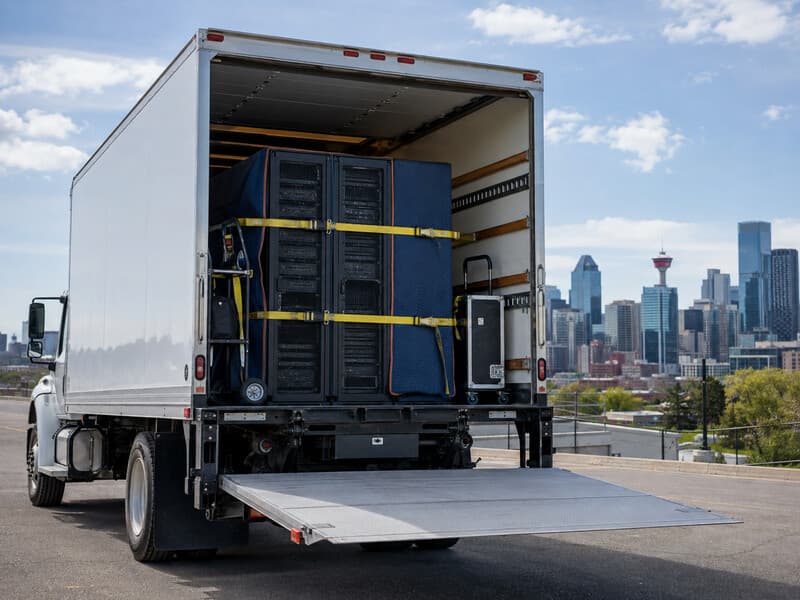
Custom carts, insured vehicles, and documented custody from dock to dock.
- 05
Re-rack & re-cable
Equipment is re-racked and re-cabled to the mapped topology at the destination.
- 06
Test & validate
Power-on, connectivity and validation testing before the project is signed off.
Track record
Floors Caliber has handed back on a Monday
The same crews that move data floors move office floors, which is why the desk audit looks like a port map. Suncor Energy, TransAlta, the Alberta Energy Regulator, Gibson Energy, ShawCor, Hitachi Solutions, Matrix Solutions and H&R Block have all had end-user environments handled to that standard: every position documented, every set labelled, every desk tested before the floor is signed off.
- Suncor Energy
- TransAlta
- Alberta Energy Regulator
- Gibson Energy
- ShawCor
- Hitachi Solutions
- Matrix Solutions
- H&R Block
Comparable projects are written up in the IT relocation case studies. Field offices, control rooms and operations floors in the energy sector are covered under oil and gas IT relocation in Alberta.
Related scope
What runs before and after the desks
The comms room behind the floor is handled as server relocation in Calgary, usually the weekend before the desks so the network is live when the floor arrives.
Where the company also runs a data floor, that scope is separate: data centre relocation in Calgary covers multi-rack and colocation migrations.
Outlets, patch fields and wireless backhaul at the destination are installed and certified by the structured data cabling crew before the first crate lands.
Retired desktops, screens and drives leave under certified IT disposal and data destruction with an asset report, instead of filling a storeroom at the new address.
Furniture, trades, building access and the IT scope under one project manager is the office relocation engagement.
Questions about lead time, insurance, after-hours work and how projects are quoted are answered in the IT relocation FAQ.
Common questions
What office managers and IT leads ask
Who packs the contents of each desk?
Staff pack their own personal items into supplied crates, labelled to their destination desk. Caliber handles everything with a cable on it: monitors, docks, towers, laptops, peripherals, headsets and power supplies. Splitting it that way keeps personal effects out of the technical inventory and keeps the technical inventory complete, which is what makes the reconnection checklist reliable.
Do you reconnect dual monitors, docking stations and peripherals as the user had them?
Yes. Each position is photographed before disconnection, including monitor arrangement, arm and mount configuration, dock model and which peripherals were attached. The destination build is rebuilt from those photographs and the desk audit. Where a user runs a non-standard setup, such as a triple-screen layout, an adjustable arm or specialised input hardware, it is recorded as such and reinstated rather than normalised to the standard desk.
What happens to desk phones, printers and multifunction devices?
Desk phones and softphone headsets move with the position and are tested on a live call. Multifunction devices are prepared to the manufacturer's transport requirements, which for most units means securing or removing the toner and imaging assembly, and they travel on appliance equipment rather than a flat cart. At the destination they are levelled, networked, and confirmed for print queues, scan-to-folder and scan-to-email destinations before handover.
Can you relocate meeting-room AV and video conferencing equipment?
Yes. Displays, wall and ceiling mounts, conferencing bars, ceiling microphones, cameras, control panels, and the cabling behind them are removed as a set and reinstated in the new room. Mounting is set out against the new room's dimensions rather than copied blind, because a display height that worked in the old room often does not suit the new one. Each room is tested on a real call before it is handed over.
Do you handle the floor switches, patch panels and wireless access points?
Yes, that is part of the IT equipment relocation scope. Comms cabinets, edge switches, patch panels, wireless access points and floor UPS units are mapped port by port before removal, moved, re-terminated and labelled to the same scheme. Where the destination cabling is new, the patching is landed against the new outlet numbering and cross-referenced to the desk audit so a given desk keeps a known path back to a known port.
How are laptops and other portable devices tracked during an office move?
Portable devices are the easiest things to lose in a move, so they are handled separately. Laptops, tablets and loan devices are inventoried by serial and asset tag, moved in locked or sealed containers, manifested, and signed for at the destination. Counts are reconciled at both ends. Where a business prefers staff to carry their own machine over the move weekend, that is recorded on the audit so the device is not chased as missing.
How do you make sure staff can work on the first morning in the new office?
The floor is not handed back on the strength of the boxes being empty. Every desk is powered on, logged in, network-tested, and checked for monitor layout, dock function, phone and printer access. Anything unresolved goes on a punch list. A technician is on the floor for the first morning to close those items and to deal with the issues that only appear when the whole floor logs in at the same time.
Can you take away the desktops and monitors we are not moving?
Yes. Equipment that is not travelling is separated at the source floor, inventoried by serial, and removed under a disposal manifest. Drives are wiped or physically destroyed to the standard you require and certificates are issued. Doing it during the move avoids the usual outcome, which is a storeroom of retired towers still holding data at the new address a year later.
Next step