Loading...
Server relocation in Calgary & Alberta
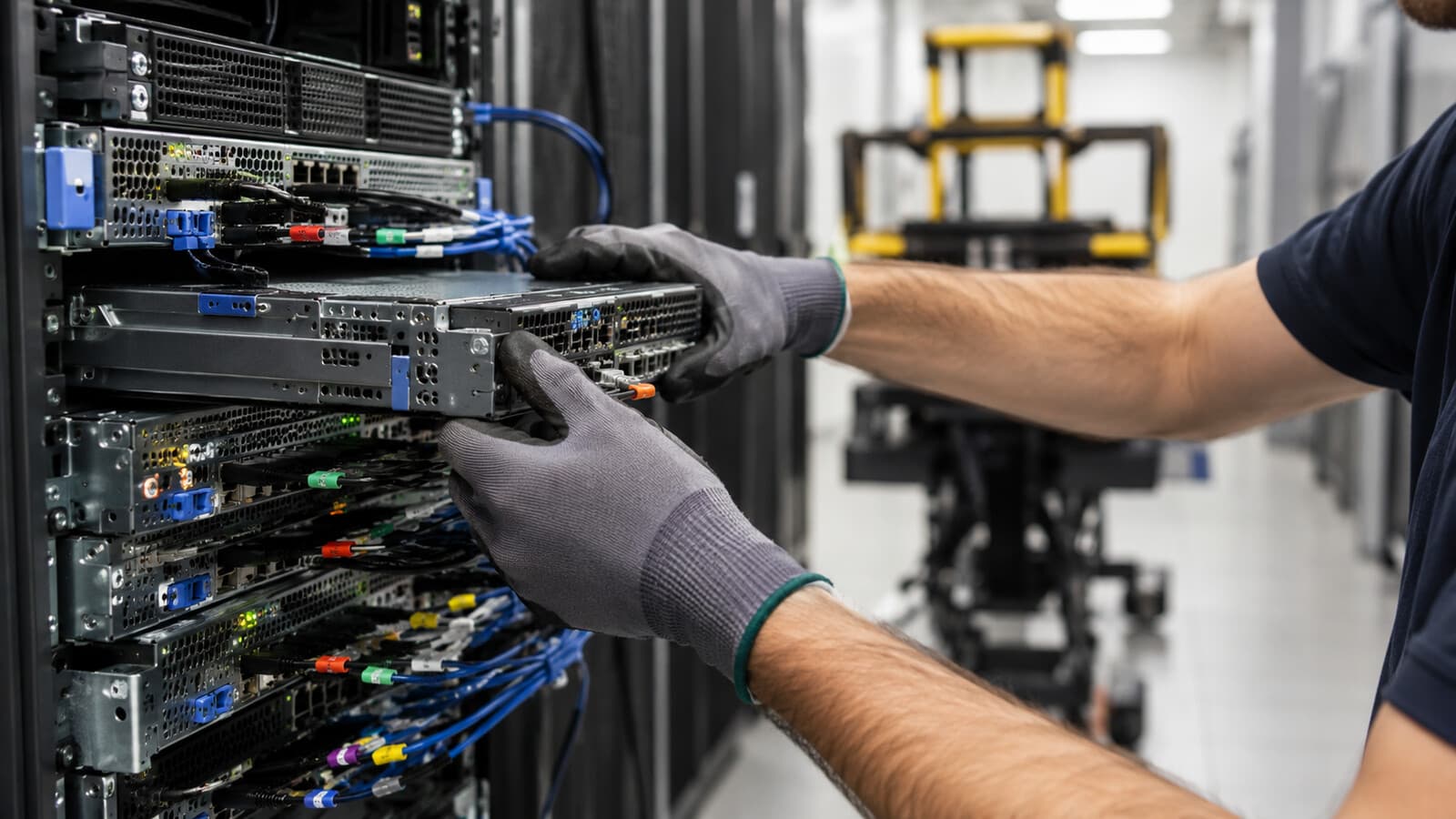
Individual servers and single-rack moves under documented chain of custody. Port-mapped, antistatic-wrapped, carried on purpose-built carts, and re-racked and validated at the destination.
Overview
The unit, the cable it was on, and who had it in between
A server move is a small project with a large blast radius. One chassis usually carries a directory service, a line-of-business database or a file share that an entire office depends on, and it rarely has a warm standby waiting. The work is therefore built around three records: what the unit is, what it was plugged into, and who was holding it at every point between the two rooms.
Caliber moves single servers, half-populated cabinets and complete single-rack rooms. That covers a floor-to-floor move inside one building, a relocation across the city, a move into a colocation cabinet, and rack-and-stack of new hardware at a destination that is being built at the same time. Caliber has been doing this work in Alberta since 2002.
Everything is port-mapped, labelled, antistatic-wrapped and re-racked to the original topology. Rails, cage nuts, bezels and cable management arms travel labelled with the chassis they came off, because the ten minutes lost to a missing rail kit at the destination comes straight out of the outage window.
Scope of work
What a server relocation includes
One unit or one full cabinet, the sequence is identical. Only the duration and the crew size change.
Per-unit asset record
Each server is inventoried by make, model, serial, asset tag and rack unit position, and photographed front and rear before anything is disconnected.
Port mapping and labelling
Every cable is labelled at both ends against the port it came from. NIC, HBA, iDRAC and iLO, out-of-band and power connections are recorded so the rebuild is a repeat, not an interpretation.
Graceful shutdown
Controlled shutdown in the order your administrators specify, confirmed at the console, with power isolated and rails released only after the unit is down.
Antistatic wrapping and boxing
Units are wrapped in antistatic material, corner-protected, and boxed or cart-mounted according to weight and chassis depth. Rail kits, cage nuts, bezels and cable management arms travel labelled with their own chassis.
Documented chain of custody
A signed manifest follows the equipment from the source room to the destination rack. Every handover is recorded, and the count is reconciled at both ends.
Purpose-built transport and insured vehicles
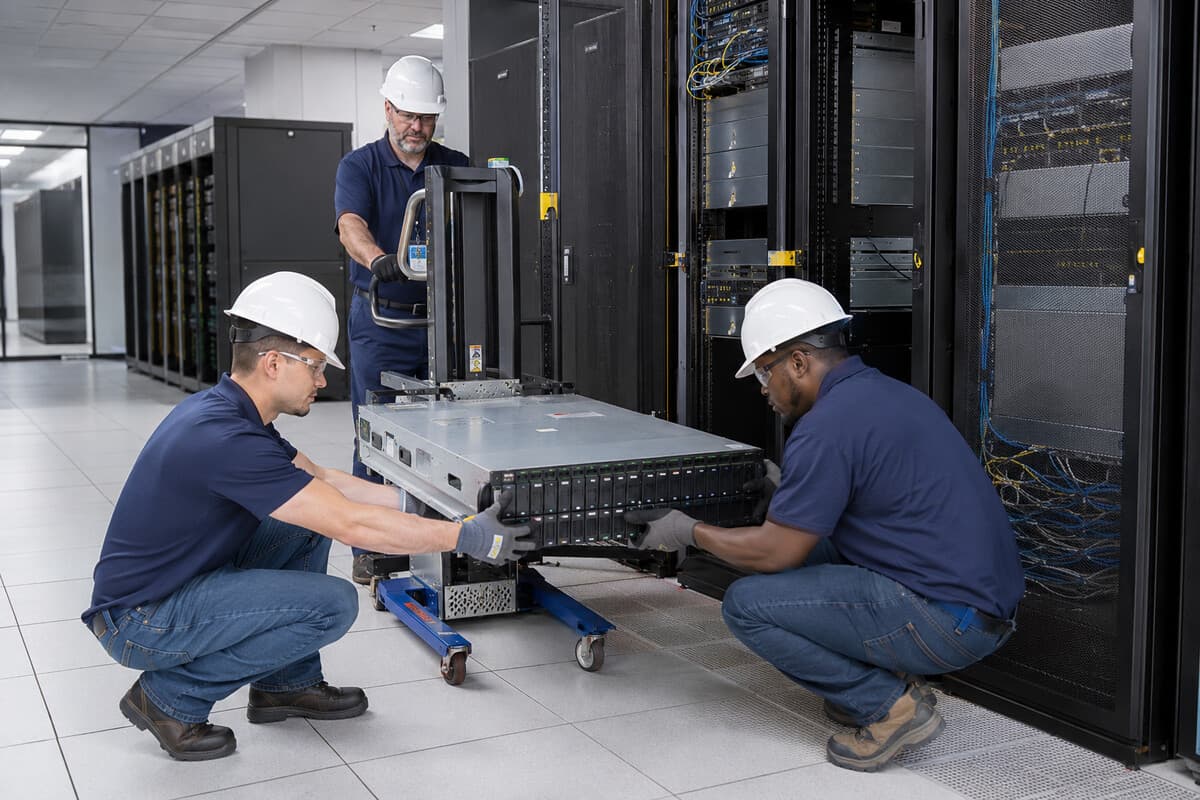
Custom equipment carts rather than furniture dollies, strapped and air-ride transported, with certificates of insurance issued for the project.
Rack and stack at the destination
Rails set to the destination cabinet depth, units landed at the mapped elevation, cable managed to the same dressing standard, and both power feeds landed on separate PDUs where the design calls for it.
Power-on and validation
Post, boot, out-of-band reachability, link state and application checks against the pre-move record, with anything unresolved carried on a punch list until it is closed.
Job shapes
Four jobs that arrive as a server move
They are quoted differently because the constraint in each one sits in a different place.
One server, one destination
A single unit moving between floors, buildings or companies. It gets the same manifest, wrapping and validation as a fifty-unit project, because a single box is usually the one running the thing nobody has a second copy of.
The single-rack room
Most Calgary offices have one cabinet in a closet: a couple of hosts, a switch stack, a firewall, a UPS and a patch panel. The cabinet either travels populated where weight and access allow, or is stripped, moved and rebuilt from the port map. Which of those applies is decided on the walkthrough, against the doorways and the elevator.
Rack and stack for new hardware
New chassis unboxed, rails fitted, units racked to the elevation drawing, cabled, labelled and handed over powered. Frequently run alongside a move so the destination cabinet is ready before the old hardware arrives.
Decommission and lift out
Servers coming out of a room that is closing. Units are shut down, wiped or physically destroyed to the standard you require, and the cabinet, cabling and UPS are removed so the space can be handed back.
Calgary coverage
Server rooms across the city and the region
Server rooms are rarely in convenient places. Access to the room usually shapes the plan more than the equipment inside it.
Downtown core and Beltline
Server rooms in tower suites, where the unit has to travel a service corridor and a booked freight elevator rather than a dock. Move windows here are set by the building, not the truck.
Quarry Park and Seton
Corporate campuses with ground-level access, where a populated cabinet can often be moved intact on a cart instead of being stripped unit by unit.
Foothills, Franklin and Shepard industrial
Plant and warehouse server rooms in the southeast industrial belt, frequently sharing space with electrical and mechanical rooms, which changes the shutdown order.
Northeast Calgary
Logistics, distribution and light industrial sites running continuous shifts, where the shutdown has to land in a narrow overnight gap between operations.
University District and the northwest
Research groups and clinics with departmental servers, where the equipment is attached to instruments and the reconnection has to be validated with the people who use them.
Airdrie, Okotoks, Cochrane and Chestermere
Branch offices and regional yards. Highway transit is planned around winter road conditions, and the move is usually sequenced so the site is back online before staff arrive.
Edmonton, Red Deer and central Alberta sites are covered from Calgary on the same terms, with transit time and winter road conditions built into the schedule rather than absorbed on the day.
Alberta operating conditions
Cold, condensation and the local calendar
A server that survived the move and then failed on power-up usually failed for one of these reasons.
Handling below −20 °C
Below roughly −20 °C, cable jackets stiffen, plastic bezels and drive carriers become brittle, and lithium cells in cache modules and UPS units lose capacity. Units are wrapped and boxed inside the building, carried out in sealed loads, and never staged outdoors. Vehicles are warmed before loading, and the walk between the door and the tailgate is treated as part of the handling plan, not as a gap in it.
Condensation before power-on
Bringing a cold chassis straight into a warm server room and energising it puts moisture onto the board. Equipment stays wrapped in the destination space until it has reached room temperature, and only then is the wrap removed and power applied. On a winter move that dwell period is scheduled explicitly, and it is the single most common thing a same-night turnaround tries to skip.
Month-end and Stampede-week freezes
Finance and energy systems in Calgary are frozen at month-end, quarter-end and year-end, and the first two weeks of July are disrupted by Stampede across most downtown offices. A server that carries billing or reporting cannot move inside those dates. The available windows are identified during scoping so the date holds.
Tower access and elevator booking
In downtown core and Beltline towers, a cabinet has to reach a booked freight elevator with a hard cut-off time, through corridors that require floor and wall protection. Elevator reservations, certificates of insurance, after-hours access and security clearance for the crew are arranged in advance. A populated cabinet that will not clear a door frame or an elevator car is identified on the walkthrough, not on the night.
Sequence
Six stages, every project
A one-unit move runs the same six stages as everything else. It just runs them in an evening.
- 01
Scope & audit
A dedicated project manager documents every asset, dependency and constraint before anything is unplugged.
- 02
Port mapping
Existing connections are mapped and labelled so the destination build matches the source exactly.
- 03
Decommission
Controlled shutdown, disconnection and antistatic wrapping by trained specialists.
- 04
Secure transport
Custom carts, insured vehicles, and documented custody from dock to dock.
- 05
Re-rack & re-cable
Equipment is re-racked and re-cabled to the mapped topology at the destination.
- 06
Test & validate
Power-on, connectivity and validation testing before the project is signed off.
Track record
Who trusts the manifest
Chain-of-custody documentation is not a formality for the clients Caliber works with. Suncor Energy, TransAlta, the Alberta Energy Regulator, Keyera, Inter Pipeline, Hitachi Solutions, Matrix Solutions and H&R Block all operate under audit obligations that reach the physical handling of hardware. The manifest, the port map and the validation record exist because those environments require them, and every smaller project gets the same paperwork by default.
- Suncor Energy
- TransAlta
- Alberta Energy Regulator
- Keyera
- Inter Pipeline
- Hitachi Solutions
- Matrix Solutions
- H&R Block
Project write-ups are published as IT relocation case studies. Clinical and personal-health environments, where drive handling and custody carry statutory weight, are covered under healthcare IT relocation in Alberta.
Related scope
Where a server move sits in a larger programme
Multi-rack floors, cage and suite migrations and phased cutovers are run as data centre relocation in Calgary, with a written cutover plan and a rollback point.
Desks, monitors, docking stations and floor network gear are the IT movers and workstation relocation scope, usually scheduled the weekend after the server room lands.
Retired chassis and drives go through certified data destruction and IT disposal with serial-level asset reporting and destruction certificates.
Destination patch fields, fibre uplinks and cabinet cabling are installed and certified by the structured data cabling crew before the units arrive.
When the server room moves because the company is moving, the whole programme runs as an office relocation with the IT scope on the critical path.
Lead times, insurance, quoting and documentation questions are answered in the IT relocation FAQ.
Common questions
What clients ask about moving servers
Can you move a single server, or is there a minimum?
There is no minimum. A single server gets the same treatment as a fifty-unit project: an asset record, a port map, antistatic wrapping, a signed custody manifest and validation on power-up. In practice the single-server jobs are often the most sensitive, because the unit is usually a line-of-business system without a warm standby.
How is chain of custody documented on a server move?
Every unit is entered on a manifest with its serial, asset tag and source position before it leaves the room. Each transfer is signed for: out of the source room, onto the vehicle, off the vehicle, into the destination cabinet. Counts are reconciled at both ends and the signed manifest is issued with the project close-out documentation. If a drive is transported separately it is manifested separately.
Do you remove hard drives and transport them separately?
Where the data class requires it, yes. Drives are pulled, bagged, labelled to their slot and carrier, manifested and moved under separate custody, then reinstated to the exact same slot at the destination so array order is preserved. This is common for regulated and personal-information workloads. It adds time at both ends, so it is agreed at the scoping stage rather than on the night.
How are servers secured inside the transport vehicle?
Units travel on purpose-built equipment carts, not furniture dollies. Carts are strapped to the vehicle wall, loads are distributed so nothing rides above a heavier item, and populated cabinets are ratchet-strapped upright with the doors secured. Vehicles are air-ride and insured for the value of the load, with certificates issued before the move.
Can you rack and stack new hardware during the same visit?
Yes, and it is the usual pattern. New chassis are unboxed, railed and racked to the elevation drawing at the destination while the existing units are still running at the source. That way the destination cabinet is cabled and powered before the moved equipment arrives, and the outage is limited to the transport leg rather than extended by a build.
How do you handle a server that will not post after re-racking?
It is worked through on site before anyone leaves. The usual causes are a seated component that shifted in transit, a power feed on the wrong PDU, or a rail or backplane connection that is not fully home. Memory, drive carriers and expansion cards are reseated, out-of-band management is checked for hardware logs, and the cabling is verified against the port map. Anything that turns out to be a genuine hardware failure is documented against that unit and escalated to your vendor with the transit record attached.
Does our systems administrator need to be on site during the move?
Someone with authority to shut systems down and confirm they are back needs to be reachable, but not necessarily present. Caliber handles the physical shutdown sequence, the move and the rebuild. The application-level confirmation at the far end is faster with your administrator on a call or on site, and most projects schedule a short validation call at power-on rather than a full overnight attendance.
Next step