Loading...
ITAD & data destruction
IT disposal Calgary — certified data destruction
Decommissioned hardware inventoried by serial number, sanitised or destroyed to the level your policy specifies, and recycled through the Alberta electronics stream. Certificates and asset reports issued against the inventory taken on your floor.
Overview
Disposal is a records problem before it is a recycling problem
The equipment leaving your building is easy to move. Proving what left, what was on it, and what happened to it afterwards is the part that gets audited.
IT asset disposition covers three obligations that are often treated as one. Data: every storage device has to be sanitised or destroyed to a level matching the classification of what was on it. The asset register: finance and audit need a serial-level record showing the asset was retired and how. Environmental: designated electronics in Alberta go through a regulated recycling stream, and batteries, displays and UPS units have their own handling rules.
Caliber handles all three as one project, from the decommission on your floor through to the certificate. Assets are inventoried where they sit, custody is signed at each transfer, media is sanitised or destroyed per serial, and the reporting reconciles line for line against the inventory captured at the start. Nothing is counted by pallet weight.
Most disposal work in Calgary arrives attached to something else: a hardware refresh, a floor consolidation, or a move where half the estate is not worth transporting. Running it inside the same project is usually cheaper, and it closes the gap where retired gear sits in a storeroom for months with live data on it — the most common way an organisation ends up with drives it cannot account for.
Where disposal runs alongside a move, it is scoped together with office relocation in Calgary so the old space is handed back empty and the new one only receives equipment that is staying in service.
Scope of work
What an IT disposal project includes
Eight elements, from the inventory taken on your floor to the certificate filed against your asset register.
Serialised asset inventory
Every unit recorded by make, model, serial number and asset tag before it leaves the floor. The inventory is the document the whole project is audited against, so it is captured on site rather than reconstructed at the depot.
Documented chain of custody
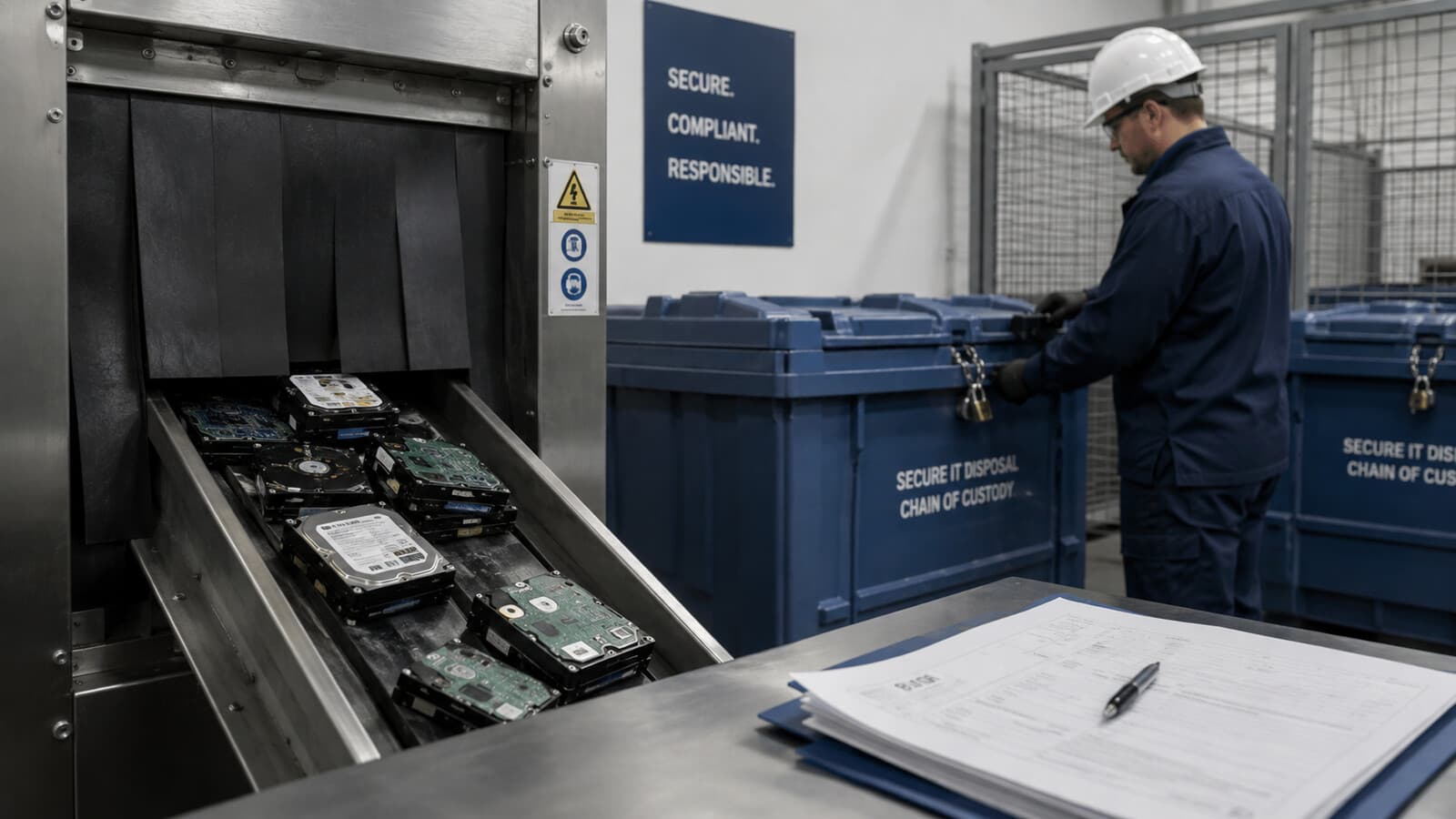
Custody is signed at each transfer: floor to cage, cage to vehicle, vehicle to processing. Sealed transport containers, a manifest that travels with the load, and a reconciliation against the original inventory at the far end.
Physical media destruction
Shredding, crushing or degaussing of hard drives, tapes and solid state media where the drive is not being returned to service. Serial numbers are recorded as each unit is destroyed, not counted as a batch.
Software sanitisation
Overwrite-based wiping for drives that will be redeployed, leased back or resold, with a per-drive pass or fail result. Drives that fail verification are pulled from the wipe stream and destroyed instead.
Certificates of destruction
A certificate listing the method used, the date, and the serial number of each device covered. Issued per project so it can be filed against the asset register and produced during an audit.
Media beyond servers and laptops
Backup tapes, SSDs and NVMe modules, phones and tablets, and the internal drives inside multifunction printers and copiers — the last of which is the most commonly missed store of scanned documents in an office.
Hazardous component handling
Lithium and lead-acid batteries, UPS units, CRT and LCD panels and lamp-backlit displays separated and documented for the correct downstream stream rather than put in a general recycling bin.
Decommission and removal
Controlled shutdown, unracking, cable removal and palletising on site. Racks, PDUs, rails and cable are taken out with the hardware so the space is handed back empty rather than half-stripped.
Sanitisation levels
Wiping and destruction are not interchangeable
NIST Special Publication 800-88 is the published media sanitisation guideline most Alberta organisations write their internal policy against. It defines three levels, and the right one depends on the data classification and on whether the media is leaving your control.
Clear
Logical overwrite using the device’s standard read and write interface. Defeats recovery with ordinary software tools. Suitable when the media stays inside the organisation.
Purge
Techniques that defeat laboratory recovery — cryptographic erase, block erase or degaussing of magnetic media. Suitable when the media leaves the organisation but is to remain usable.
Destroy
Shredding, disintegration or incineration. The media is no longer usable and cannot be reintroduced. Used where the data classification does not permit anything else.
Caliber works to the level your policy specifies and records which level was applied to which serial number. That matters at audit: a report saying “drives wiped” does not tell an assessor whether a Clear or a Purge was performed, and those are different assurances.
Solid state media is where this goes wrong most often. Overwrite passes designed for spinning disks do not map cleanly onto flash translation layers and over-provisioned blocks, which is why cryptographic erase or physical destruction is the usual answer for SSD and NVMe. Backup tapes are degaussed or shredded rather than written over.
Chain of custody
Every transfer is signed, and the manifest travels with the load
Custody starts on your floor, not at the loading dock. Units are recorded by serial number where they sit, then sealed into transport containers with a manifest attached. The person releasing the equipment signs, the person taking it signs, and the same happens at the vehicle and again at the processing facility.
At the far end, the manifest is reconciled against the original inventory before processing begins. A count that does not match is raised at that point, while it is still possible to work out where the unit went — a week later it is simply a missing asset.
For regulated clients the record set is the deliverable. Energy, healthcare and financial organisations in Calgary have to show, per asset, what classification it held, how it was sanitised, when and by whom. The reporting is structured to drop into an existing asset register rather than be transcribed.
Healthcare clients handling records under Alberta’s health information legislation have the tightest requirement here, which is covered further on the healthcare IT relocation page.
Calgary coverage
Where e-waste and decommissioned equipment gets collected
Removal logistics change more between a downtown tower and a Foothills warehouse than the disposal process itself does.
Downtown core and Beltline
Pallets and cages out through a booked freight elevator and a shared loading dock with a time-limited slot. Equipment is staged on the floor, inventoried, and moved in a single elevator window rather than trickled down over a day.
Quarry Park and Seton
Campus buildings with at-grade docks and room to stage. These sites usually allow a full decommission and inventory in one visit, including racks, PDUs and cable rather than just the servers.
Foothills, Franklin and Shepard
Industrial sites, where the volume is often larger and mixed: shop-floor terminals, UPS units, batteries and older display stock alongside the office estate. Hazardous components are separated at the point of collection.
Northeast and University District
Mixed office and light industrial in the northeast, and dense multi-tenant floors in the University District where access is through shared corridors and service lifts booked with the property manager.
Airdrie, Okotoks, Cochrane, Chestermere
Branch and satellite sites collected on a scheduled run. Serial capture happens at each site so a multi-site disposal still produces one reconciled report rather than four partial ones.
Data centre and colocation floors
Cage decommissions where the exit condition is contractual: rails, cable, PDUs and blanking panels all out, floor swept, and the cage handed back to the operator. Usually run as the tail end of a data centre relocation.
Alberta operating conditions
Cold weather changes how retired hardware is handled
Below roughly −20 °C, plastics on older chassis, bezels and display housings become brittle and crack under handling that would be harmless in summer. Lithium cells lose capacity and are more easily damaged, and a damaged lithium cell in a pallet of retired laptops is a fire risk rather than an inconvenience. Batteries are separated and packed before transport rather than after.
Condensation applies in reverse to disposal work. Equipment carried from a cold loading dock into a warm processing area collects moisture on boards and platters. Units are allowed to equalise before any drive is powered up for wiping, because a drive that fails a wipe on a condensation fault has to be destroyed instead, and that is an avoidable loss of resale value.
Scheduling follows the same Calgary calendar as every other project. Month-end is a freeze window for finance and energy tenants, so bulk removals are booked away from the last and first business days of the month. Stampede week removes downtown dock availability and most of the client-side approvers who have to sign a custody transfer.
Downtown towers require freight elevator booking days in advance, frequently for evening slots only, and after-hours building access needs each technician cleared with security before the shift rather than at the door. Pallet weight limits and dock height also decide whether racks come out whole or are stripped on the floor first.
Sequence
Six stages, every project
A disposal runs on the same sequence as a relocation. The difference is the destination: the mapped topology at stage five is the one being retired, and validation at stage six is a reconciled asset report rather than a power-on test.
- 01
Scope & audit
A dedicated project manager documents every asset, dependency and constraint before anything is unplugged.
- 02
Port mapping
Existing connections are mapped and labelled so the destination build matches the source exactly.
- 03
Decommission
Controlled shutdown, disconnection and antistatic wrapping by trained specialists.
- 04
Secure transport
Custom carts, insured vehicles, and documented custody from dock to dock.
- 05
Re-rack & re-cable
Equipment is re-racked and re-cabled to the mapped topology at the destination.
- 06
Test & validate
Power-on, connectivity and validation testing before the project is signed off.
Track record
Handling retired equipment for organisations that get audited
Caliber has worked with Alberta infrastructure since 2002. The client list includes Suncor Energy, TransAlta, the Alberta Energy Regulator, Rogers Data Centres, Keyera, Inter Pipeline, Gibson Energy, ShawCor, Hitachi Solutions, Matrix Solutions and H&R Block. In those environments the disposal report is read by someone who will check it against an asset register, which is why the reporting is built at serial level from the first hour of the project.
See the IT relocation case studies for how decommission and disposal are sequenced inside larger projects, or the IT relocation FAQ for questions about insurance, scheduling and how projects are quoted.
Related services
- Server relocation with documented chain of custody — the same custody records, applied to gear that is staying in service.
- Data centre relocation in Calgary — cage decommission and handback after the migration.
- IT movers for workstations and network gear — refresh projects where old and new estates overlap.
- Structured cabling in Calgary — stripping abandoned cable when a floor is handed back.
- Oil and gas IT relocation in Alberta — field and control room equipment retirement.
Common questions
What clients ask about IT disposal
What is the difference between wiping a drive and physically destroying it?
Wiping overwrites the data and leaves the drive usable, which matters when a machine is being redeployed internally, returned at the end of a lease, or sold. Physical destruction shreds or crushes the media so it can never be read or reused, and the drive has no residual value afterwards. Wiping is verified drive by drive; a drive that fails verification is destroyed instead. The decision is usually made per asset class rather than for the whole project.
What do NIST 800-88 Clear, Purge and Destroy mean?
NIST Special Publication 800-88 is the published media sanitisation guideline most organisations write their own policy against. Clear is a logical overwrite through the device interface that defeats ordinary software recovery. Purge covers techniques that defeat laboratory recovery, such as cryptographic erase, block erase or degaussing of magnetic media. Destroy means shredding, disintegration or incineration, after which the media cannot be reused. The right level is set by the data classification and by whether the media is leaving your control; Caliber works to the level your policy specifies.
What appears on a certificate of destruction?
The certificate lists the sanitisation or destruction method applied, the date it was carried out, and the serial number of each device covered. It reconciles against the serialised inventory captured on site, so an auditor can trace a specific asset tag from your register to a line on the certificate. A certificate stating only a weight or a unit count cannot do that.
How do you track assets between our building and the recycler?
Custody is signed at every handover. Equipment is inventoried and sealed into transport containers on your floor, a manifest travels with the load, and the receiving side reconciles the manifest against the inventory before processing starts. Any discrepancy is raised against the manifest rather than resolved quietly, and the same records support the disposal entry in your asset register.
Where do decommissioned electronics go in Alberta?
Designated electronics in Alberta are handled through the provincial electronics recycling program administered by the Alberta Recycling Management Authority, which is why an environmental fee is charged on many devices at the point of sale. Downstream, units are separated into material streams: boards and metals for recovery, plastics, and regulated components such as batteries, lamp-backlit displays and CRT glass. Caliber documents which stream each category went to in the disposal report.
Can we witness the destruction of our drives?
Yes. Witnessed destruction is arranged where a policy or a client’s auditor requires it, and it changes the schedule rather than the method — the destruction is done at a time your representative can attend, with the serial list read and confirmed as units are processed. Some clients instead require drives to be removed and destroyed before the chassis leaves the building, which is also supported.
What happens to equipment that still has resale value?
It is separated during the inventory rather than after. Assets with residual value are sanitised to the level your policy specifies, tested, and reported back to you as a separate line on the asset report so the value can be handled under your own disposal policy. Nothing with recoverable data leaves the sanitisation stream on the basis of resale value; the data decision is made first and the commercial one second.
Do drives have to be removed from servers before they leave our site?
Not always, but it is common for regulated environments and it is the safer default. Pulling drives on site reduces the transport risk to hardware that no longer holds data, and it lets the drive serials be reconciled against the chassis serials while both are still in front of you. Where drives stay in the chassis, the unit is sealed and tracked as a single custody item until sanitisation. Either approach is documented the same way; the choice belongs to your security policy.
Next step