Loading...
Commercial moves
Office relocation Calgary — furniture and IT, one team
The whole office move, run on one schedule, by a team that treats the technical scope as the critical path. Desks, crates, cabling, network and servers planned together so staff sit down on Monday to a floor that works.
Overview
The furniture is the easy half
Desks and cabinets can be moved by any crew with a truck. What decides whether Monday works is the order the technical scope is done in, and who is accountable when a stage slips.
An office relocation in Calgary usually gets split between two suppliers: commercial movers for the furniture and contents, and an IT vendor or the internal team for everything with a cable on it. The split looks efficient on paper. In practice it creates a dependency nobody owns. Cabling finishes late, so the rack cannot be built; the rack is late, so the network is not up; and the rebuilt workstations have nothing to connect to on the first morning.
Caliber runs both halves under one plan. The same project manager scopes the furniture inventory and the equipment inventory, sets the sequence, holds the building bookings at both addresses, and signs off each stage before the next one starts. Furniture is scheduled around the technical work rather than the other way round, because furniture can absorb a delay and a network cutover cannot.
That suits organisations where the office is also an operations centre: engineering firms with licence-locked workstations, energy companies with on-premise servers, and any tenant whose staff cannot work without a live port. It is also why a general commercial mover is often the wrong single supplier for these moves, however good the crew is with furniture.
Where the scope is only the equipment — workstations, network gear and the floor’s IT footprint, with your own mover handling furniture — that is scoped separately as IT equipment relocation. Most clients take the combined scope, because the coordination is the part that costs them.
Scope of work
What an office relocation includes
Eight elements, covering both the physical move and the technical scope that decides whether the first day works.
One project manager, one schedule
A single manager owns the furniture scope and the technical scope. There is no seam between the mover and the IT vendor, which is where most office moves lose their Monday morning.
Move plan and floor plan execution
Every desk, cabinet, monitor and printer is assigned a destination position from the new floor plan before anything is packed. Zones and positions are numbered, and the label on the crate matches the number on the wall.
Furniture and general contents
Workstations, height-adjustable desks, task chairs, filing and lateral cabinets, lockers, boardroom tables and reception furniture disassembled, protected, transported and rebuilt in place.
Workstation disconnect and reconnect
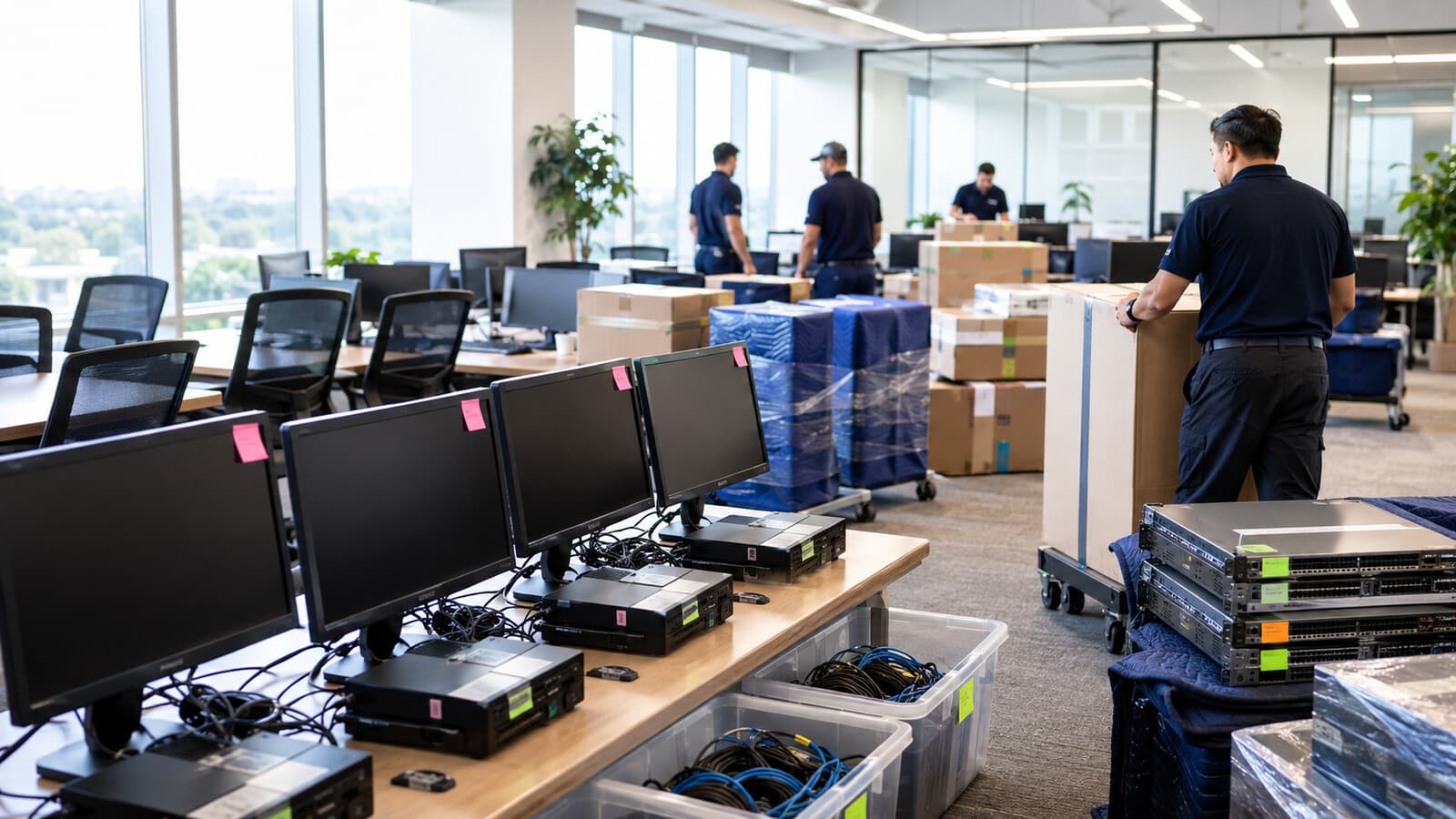
Machines, docks, monitor arms, handsets and peripherals photographed, disconnected, moved and rebuilt at the assigned position, so a user returns to the setup they left rather than a box of cables.
Network and server cutover
Switches, firewalls, UPS units and on-premise servers moved on a planned window, re-racked to the mapped topology, and validated before staff arrive rather than during their first shift.
Building and landlord requirements
Certificates of insurance, freight elevator bookings, dock windows, floor and wall protection, security clearance for after-hours access, and the tenant rules that apply to each end of the move.
Crate, label and asset control
Numbered crates issued per person and per room, with a manifest so a missing item is traceable to a zone rather than to the whole building. Assets are tracked between the two addresses.
Old space decommission and handback
Cable stripped, racks and PDUs removed, furniture disposed of or resold, and the space left in the condition the lease requires so the deposit is not spent on somebody else’s cleanup.
Move plan
What the eight weeks before move day look like
Office moves fail on lead time, not on move day. Cabling, carrier delivery and building bookings all have to be closed before the trucks are relevant.
- T−8 weeks
Survey both addresses
Inventory of furniture and equipment, floor plan positions, building rules at each end, and confirmation of what the new space still needs before it can receive anything.
- T−4 weeks
Infrastructure first
Cabling, patch panels and the communications room completed and certified. Circuits confirmed live. Nothing else on the schedule is safe until this is done.
- T−1 week
Crates and labels out
Numbered crates delivered, zone plans posted, staff briefed on what they pack and what they leave. Elevator and dock windows confirmed in writing.
- Move window
Sequenced, not simultaneous
Servers and network first, then furniture, then workstations. Each stage lands before the next depends on it, and each is signed off as it completes.
- Day one
Floor walk and support
Staff arrive to positions that are built, plugged in and tested. Technicians stay on site for the first day to clear the small faults that only appear under real use.
- Handback
Old space closed out
Decommission of the vacated floor, removal of abandoned cable and racks, and the disposal report for anything retired instead of moved.
The longest lead item on most Calgary office moves is the carrier circuit at the new address. Internet and WAN delivery dates sit outside the move team’s control and they slip, so the circuit is confirmed and tested before the date is locked, not after.
The second is structured cabling. A floor cannot receive equipment until its links are terminated, certified and mapped to the patch panel, which is why data cabling in Calgary is scheduled four weeks ahead of the move window rather than the week before it.
Calgary coverage
Where office moves in Calgary actually get complicated
Two addresses, two sets of building rules. The constraints change street by street more than most tenants expect.
Downtown core
Freight elevator booking, a shared dock with a fixed window, certificates of insurance naming the landlord, and protection on floors, walls and elevator cabs. Most tower moves can only run evenings and weekends, and the elevator, not the crew, sets how much gets done per shift.
Beltline
Converted and mid-rise stock with narrow docks, tight street access and limited staging space. Loads are broken down smaller and staged in more passes, and parking permits sometimes decide the start time.
Quarry Park and Seton
Campus buildings with at-grade docks and generous staging. The easiest destinations to move into, and the sites where a full floor can be built and tested inside a single weekend.
Foothills, Franklin and Shepard
Industrial and flex space, where an office move usually also involves shop equipment, plan storage, shipping terminals and a server room that was built into a converted storage closet.
Northeast and University District
Light industrial and multi-tenant office in the northeast, and dense mixed-use floors in the University District where access runs through shared corridors and service lifts booked with the property manager.
Airdrie, Okotoks, Cochrane, Chestermere
Moves out of Calgary to lower-cost space, and branch offices consolidating into the city. Highway transit adds a weather variable in winter, so these are scheduled with a contingency day rather than a fixed single window.
Alberta operating conditions
A Calgary office move is a winter problem for half the year
Below roughly −20 °C, equipment handling changes. LCD panels are not powered until they have reached room temperature, laptop and UPS batteries are kept out of unheated transit, and plastics on older furniture and chassis become brittle enough to crack under normal handling. Loads are staged inside and dock doors are kept closed between passes rather than propped open for the shift.
Condensation is the failure that costs hardware. A server carried from a −25 °C truck into a warm server room will collect moisture on its boards, and powering it up before it has equalised is how a move turns into a replacement. Equipment is acclimatised before the power-on stage, which is one of the reasons the technical scope needs its own window rather than being squeezed in behind the furniture.
The Calgary calendar constrains the date as much as the weather does. Month-end is a freeze window for finance, energy and professional services tenants, so moves are booked away from the last and first business days of the month. Stampede week removes downtown dock slots, elevator availability and a large share of the people whose sign-off the move depends on.
Downtown towers require freight elevator bookings days in advance, commonly for after-hours slots only, and after-hours building access means every technician on the crew is cleared with security before the shift rather than at the desk on the night. Snow clearing at both docks, and a route that does not rely on a single loading bay, are part of the plan from November onward.
Sequence
Six stages, every project
The technical scope inside an office move runs the same six stages as a standalone equipment relocation, with the furniture schedule built around it.
- 01
Scope & audit
A dedicated project manager documents every asset, dependency and constraint before anything is unplugged.
- 02
Port mapping
Existing connections are mapped and labelled so the destination build matches the source exactly.
- 03
Decommission
Controlled shutdown, disconnection and antistatic wrapping by trained specialists.
- 04
Secure transport
Custom carts, insured vehicles, and documented custody from dock to dock.
- 05
Re-rack & re-cable
Equipment is re-racked and re-cabled to the mapped topology at the destination.
- 06
Test & validate
Power-on, connectivity and validation testing before the project is signed off.
Track record
Moving Alberta offices since 2002
Caliber has been relocating Alberta offices and infrastructure since 2002. The client list includes Suncor Energy, TransAlta, the Alberta Energy Regulator, Rogers Data Centres, Keyera, Inter Pipeline, Gibson Energy, ShawCor, Hitachi Solutions, Matrix Solutions and H&R Block — tenants whose moves are governed by building rules, audit requirements and change-freeze calendars rather than by how fast a truck can be loaded.
The IT relocation case studies show how the furniture and technical scopes are sequenced on real projects. Energy tenants moving trading floors and control rooms should also read the oil and gas IT relocation page, and the IT relocation FAQ covers insurance, after-hours work and how projects are quoted.
Related services
- Structured cabling in Calgary — the new floor has to be cabled and certified first.
- Server relocation with documented chain of custody — for the on-premise rack that moves with you.
- IT equipment and workstation relocation — when another mover is handling the furniture.
- IT disposal and certified data destruction — for everything not worth moving to the new address.
- Data centre relocation in Calgary — when the move includes a full facility, not a server room.
Common questions
What clients ask about office moves
Who owns the schedule when furniture and IT are moving the same weekend?
One project manager does. That is the argument for using commercial movers in Calgary who also hold the technical scope: when furniture and IT sit with two vendors, the schedule has a seam in it, and the seam fails the same way every time — the furniture crew finishes Saturday, the IT vendor arrives Sunday to find the server room stacked with crates, and staff lose Monday. One schedule with one owner removes the handoff.
What has to be finished in the new space before move weekend?
Structured cabling installed, terminated and certified. Communications room fitted with the rack, patch panels and power it needs. Building circuits live and the internet or WAN service delivered and tested by the carrier, which is usually the longest lead item and the one most often assumed rather than confirmed. Locks, security access and floor plan sign-off should also be closed. If cabling is still in progress the week before, the move date is what has to change.
Can you work around a month-end close or Stampede week?
Yes, and in Calgary you generally have to. Finance and energy tenants freeze system changes over month-end, so moves are scheduled away from the last and first business days of the month. Stampede week takes out downtown dock and elevator availability, building access, and a large share of the approvers who need to sign off on the move. Both are treated as fixed constraints when the date is set.
Who handles certificates of insurance, elevator booking and dock time?
Caliber does, at both addresses. Downtown towers require a certificate of insurance naming the landlord, freight elevator booking days in advance and usually outside business hours, a dock window with a fixed start and end, and protection on floors, walls and elevator cabs. After-hours access means each technician is cleared with building security before the shift. All of it is confirmed in writing before the move date is treated as firm.
What happens to the space we are leaving?
The vacated floor is decommissioned as part of the same project: abandoned cable pulled, racks, PDUs and rails removed, and furniture either transported, resold or disposed of. Equipment that is not moving is inventoried by serial number and handled through certified data destruction and recycling. Most commercial leases put the cost of a poor handback onto the tenant, so closing the old space is part of the move.
How do you sequence a move across several floors of a downtown tower?
Floor by floor, against one elevator. A tower move is limited by the freight elevator and the dock, not by crew size, so the plan is built backwards from how many cage loads fit in a booked window. Each floor is completed and signed off before the next starts, so a delay hits one department rather than the building. Where the destination is also a tower, both bookings have to line up, and that usually decides the move date.
What do staff need to do before they leave on the Friday?
Pack personal items and desk contents into their numbered crate, label it with their assigned position number, and leave the technology alone. Monitors, docks, cables, handsets and machines are disconnected by the crew and photographed first so they can be rebuilt exactly. Anything needed on Monday morning should travel with them rather than in a crate; clear guidance on that removes most day-one problems.
How do you handle a phased move where part of the team stays behind?
Both sites have to work at every point in the schedule, which means the network and phone systems are cut over in stages rather than at once. Departments are grouped so the ones that depend on each other move together, shared infrastructure such as printers and file storage is duplicated or moved last, and the remaining space is consolidated as it empties. Phased moves take longer and need a longer runway, but they suit organisations that cannot take a weekend of downtime.
Next step